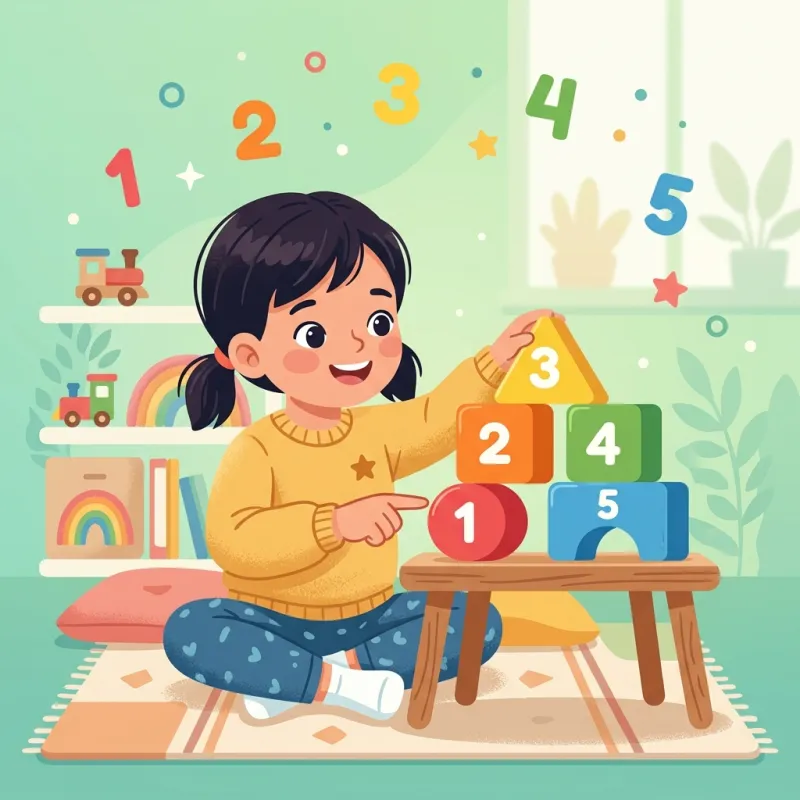
When a toddler picks up a square block and tries to push it through a round hole, they are doing far more than playing — they are conducting an experiment in spatial reasoning. Shape recognition is one of the earliest and most important cognitive skills that children develop, and it has profound implications for mathematical thinking, reading readiness, and problem-solving abilities that extend well beyond early childhood.
How Spatial Awareness Develops
Spatial awareness — the ability to understand the properties and relationships of objects in space — begins developing from birth. Newborns can distinguish between simple shapes, showing preferences for curved forms over angular ones. By six months, infants can mentally rotate simple shapes and recognize them from different angles. By their first birthday, most children can distinguish between circles, squares, and triangles, even though they cannot yet name these shapes.
The progression from perceiving shapes to naming them follows a predictable sequence. Children first learn to match identical shapes — placing a circle on top of another circle. Next, they learn to match shapes regardless of size — recognizing that a small circle and a large circle are both circles. Then they learn to match shapes regardless of orientation — understanding that a triangle is still a triangle when turned upside down. Finally, they learn the names of shapes and can identify them verbally.
Shape Recognition and Mathematics
Research in mathematics education has established a strong link between early shape knowledge and later mathematical achievement. The National Council of Teachers of Mathematics identifies geometry and spatial sense as one of the five key content areas for early childhood mathematics, alongside number sense, measurement, patterns, and data analysis.
Shape recognition is foundational to mathematics for several reasons. Understanding shapes requires children to identify properties — a square has four equal sides and four corners. This analytical thinking is the same mental process used in algebraic reasoning. Comparing shapes involves understanding concepts like "same," "different," "bigger," and "smaller" — the conceptual vocabulary of measurement and comparison. Combining shapes to create new forms (two triangles make a square) is the conceptual precursor to addition and multiplication.
Studies have shown that children who enter kindergarten with strong shape knowledge score higher on standardized mathematics assessments in later grades. This is not because shape knowledge directly determines math ability, but because the cognitive processes exercised through shape learning — analysis, comparison, mental rotation, spatial reasoning — are the same processes that underlie mathematical thinking.
Shape Recognition and Literacy
Perhaps surprisingly, shape recognition also plays a crucial role in reading readiness. Letters are, at their most fundamental level, combinations of lines, curves, and angles — in other words, shapes. A child who can distinguish between a circle and an oval, or between an angle and a curve, is better equipped to distinguish between visually similar letters like "b" and "d" or "p" and "q."
Research by educational psychologist Dr. Robert Siegler has shown that children who struggle with shape discrimination often also struggle with letter discrimination. By strengthening a child's ability to notice and describe the properties of shapes, parents are simultaneously preparing them for the visual discrimination tasks required for reading.
Teaching Shapes Effectively
The most effective shape instruction goes beyond simple naming to build deep conceptual understanding. Here are strategies supported by research.
- Use varied examples: Show children many different examples of each shape. A circle is not just a perfect circle drawn on paper — it is also a plate, a wheel, a coin, and a pizza. Exposure to varied examples helps children form a flexible, accurate concept of each shape rather than a rigid prototype.
- Discuss properties: Instead of just saying "This is a triangle," say "This is a triangle. It has three sides and three points." Focusing on defining properties rather than just visual appearance prepares children for more advanced geometric thinking.
- Shape hunts: Walk around your home or neighborhood and challenge your child to find examples of each shape. Doors are rectangles, clocks are circles, roof tops are triangles. This connects abstract shape concepts to the real world and sharpens observational skills.
- Digital reinforcement: Use apps like Sikho Kids' shapes module to provide systematic exposure to a variety of shapes with clear visual presentations and audio naming. The consistent, uncluttered format helps children focus on the essential properties of each shape without the visual noise of complex real-world scenes.
- Building and creating: Provide blocks, tangram puzzles, and art materials that allow children to compose and decompose shapes. These hands-on activities build spatial reasoning and creative problem-solving skills simultaneously.
Common Misconceptions to Avoid
Many well-meaning parents and teachers inadvertently create misconceptions about shapes by presenting only prototypical examples. If a child only ever sees equilateral triangles pointing upward, they may not recognize a long, thin triangle or a triangle with one angle pointing downward as a triangle. Similarly, if rectangles are always shown with the long side horizontal, children may fail to recognize a vertical rectangle.
To prevent these misconceptions, intentionally vary the examples you present. Show triangles in all orientations and proportions. Show rectangles in various aspect ratios. Show circles of different sizes. And explicitly discuss what makes a shape belong to its category — it is the properties (number of sides, types of angles) that define a shape, not its size, color, or orientation.
Beyond Basic Shapes
Once children master basic shapes (circle, square, triangle, rectangle), they are ready for more complex geometric concepts. Introduce ovals, diamonds, pentagons, hexagons, and stars. Explore three-dimensional shapes — spheres, cubes, cylinders, and cones. Discuss symmetry — which shapes look the same when folded in half? Introduce transformations — what happens when you flip, slide, or rotate a shape?
These advanced concepts may seem ambitious for preschoolers, but research consistently shows that young children are capable of far more sophisticated spatial reasoning than traditional curricula give them credit for. When presented in playful, engaging formats — whether through physical manipulatives or well-designed digital tools — even complex geometric concepts can be accessible and exciting for young learners.
Every time a child fits a block into a shape sorter, they are building the neural architecture for mathematical reasoning. Every shape mastered is a foundation stone for future learning.