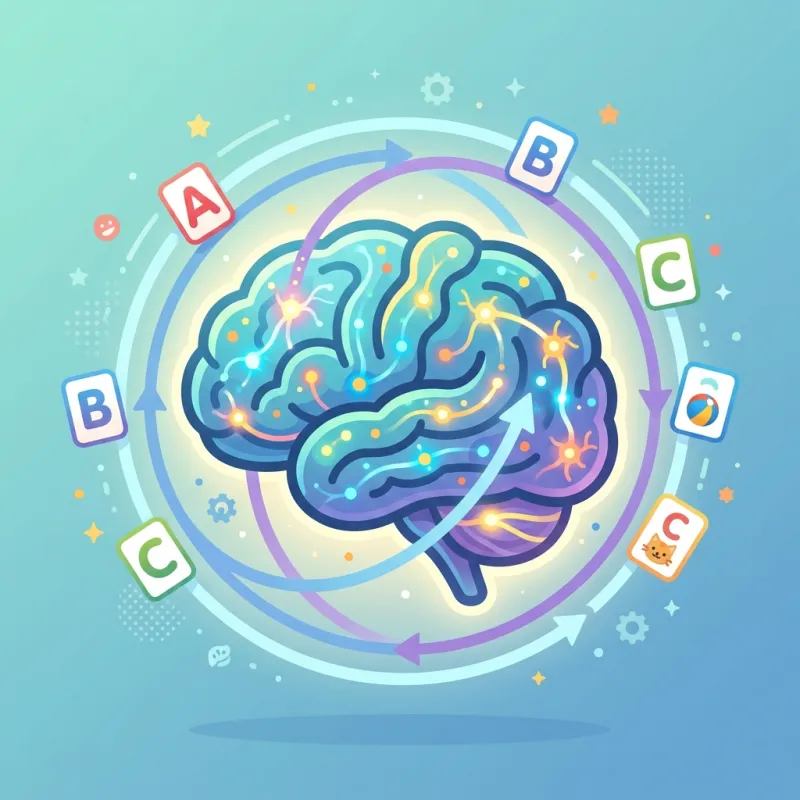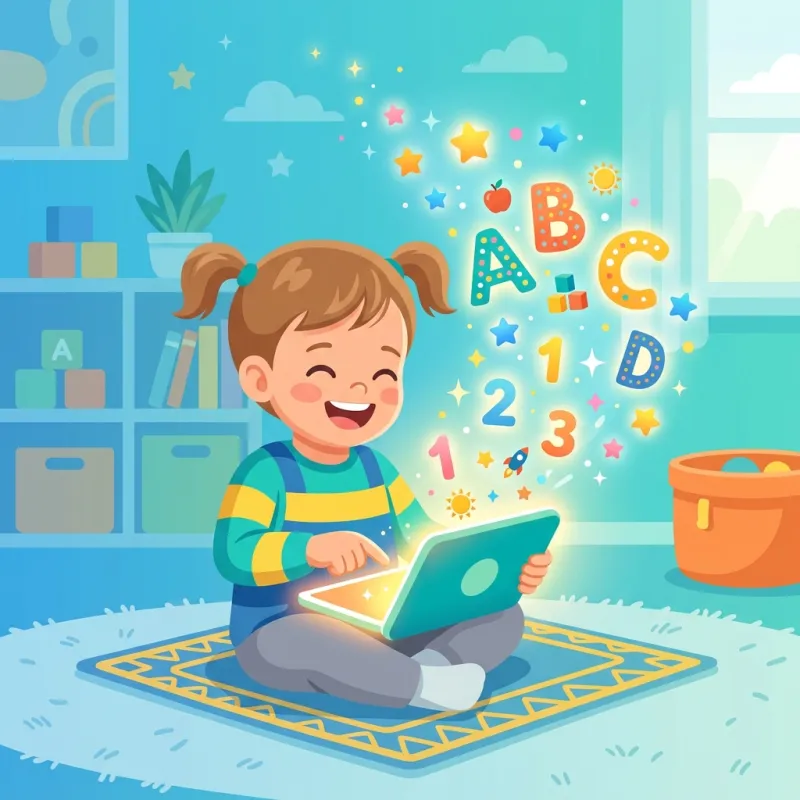
Close your eyes and think of an apple. You probably see its red skin and hear the crunch of biting into it simultaneously. This is because your brain does not store visual and auditory information in separate, isolated compartments — it weaves them together into rich, multisensory memories. Young children's brains are especially adept at this kind of cross-modal integration, which is why educational approaches that combine audio and visual cues consistently outperform single-modality instruction.
The Dual Coding Theory
In 1971, psychologist Allan Paivio proposed the Dual Coding Theory, which remains one of the most influential frameworks for understanding how humans process and remember information. The theory posits that our cognitive system operates through two distinct but interconnected channels: a verbal channel that processes language and sounds, and a non-verbal channel that processes images and spatial information.
When information is presented through only one channel — say, a spoken word — it creates a single memory trace. But when the same information is presented through both channels simultaneously — a spoken word accompanied by a corresponding image — it creates two interconnected memory traces. This dual encoding dramatically improves the probability of successful recall, because the information can be accessed through either channel independently.
For young children who are still developing their language skills, the visual channel often serves as a scaffold for the verbal channel. A toddler who does not yet know the word "elephant" may not retain the spoken word alone. But when the word is paired with a vivid image of an elephant, the visual memory anchors the auditory memory, making both more accessible.
How Audio Cues Support Learning
Audio cues serve several distinct functions in early childhood learning, each contributing to cognitive development in different ways.
Pronunciation modeling: For language learning, hearing the correct pronunciation of words is essential. Children learn to speak by imitating the sounds they hear, and they need clear, consistent models to develop accurate pronunciation. Educational apps like Sikho Kids provide professional-quality audio pronunciation for every item in every category, giving children a reliable model they can hear as many times as needed through the Repeat Mode feature.
Attention direction: Sound naturally captures attention. A soft chime when a new flashcard appears, or a distinct pronunciation when a letter is displayed, signals to the child that something important is happening. This auditory alerting helps direct visual attention to the relevant content, improving focus and information uptake.
Emotional engagement: The tone, rhythm, and musicality of audio can create emotional responses that enhance memory formation. A warm, encouraging voice saying "Well done!" triggers positive emotions that the brain associates with the learning experience. Over time, these positive associations build intrinsic motivation to continue learning.
Phonological awareness: For literacy development, audio exposure to letter sounds and word patterns builds phonological awareness — the ability to recognize and manipulate the sound structure of language. This skill is one of the strongest predictors of later reading success.
How Visual Cues Support Learning
Visual information is processed extraordinarily quickly by the human brain — research suggests we can identify a familiar image in as little as thirteen milliseconds. This processing speed makes visual cues highly efficient learning tools for young children.
Concrete representation: Abstract concepts become concrete and graspable when represented visually. The number "5" is an abstract symbol, but five colorful apples arranged on screen make the concept of "five-ness" tangible and intuitive.
Color and contrast: The use of color in educational materials is not merely decorative — it serves cognitive functions. High-contrast color combinations improve visual discrimination. Color coding helps children categorize information. And the emotional associations of different colors (warm reds for excitement, cool blues for calm) can be used to create appropriate learning moods.
Spatial organization: How information is arranged visually affects how it is processed cognitively. Clean, uncluttered layouts with clear focal points reduce cognitive load and help children direct their attention to the most important content. This is why the best educational apps use simple, spacious designs rather than cramming screens with competing visual elements.
The Power of Synchronization
The real magic happens when audio and visual cues are precisely synchronized. When a child sees a letter appear on screen at the exact moment they hear its sound, the temporal coincidence strengthens the association between the visual symbol and its auditory counterpart. This is the principle of temporal contiguity, and it is one of the most powerful learning mechanisms available.
Poorly synchronized audio-visual presentations can actually hinder learning by creating confusion about which sounds correspond to which images. This is why high-quality educational apps invest significant effort in ensuring that visual transitions and audio cues are perfectly aligned. In Sikho Kids, each flashcard's image and audio pronunciation are synchronized to present a unified, coherent learning stimulus.
Practical Implications for Parents
Understanding the power of audio-visual learning has several practical implications for how parents can optimize their child's learning environment.
- Choose apps wisely: Look for educational apps that combine clear visuals with high-quality audio, rather than relying on one modality alone. Silent flashcard apps miss the auditory encoding opportunity, while audio-only apps miss the visual one.
- Read aloud with pictures: When reading to your child, point to the illustrations as you read the corresponding words. This synchronized audio-visual presentation maximizes memory formation.
- Name what you see: Throughout the day, narrate your child's visual experiences. When they look at a bird, say "Bird! Look at the blue bird." When they pick up a yellow block, say "Yellow! You found a yellow block." This constant pairing of visual experience with verbal labels accelerates vocabulary development.
- Leverage device features: When using learning apps, ensure the device volume is at a comfortable level and the screen is clearly visible. Learning opportunities are diminished when audio is too quiet to hear clearly or visuals are obscured by screen glare.
Beyond Sight and Sound
While audio and visual cues are the most commonly leveraged sensory channels in digital learning, the principle of multisensory engagement extends further. Touch interaction on tablets adds a kinesthetic dimension. Physical manipulatives add tactile feedback. Movement and gesture add proprioceptive input. The more sensory channels engaged in a learning experience, the richer and more durable the resulting memories.
The eyes and ears are not just receivers of information — they are gateways to understanding. When we open both gateways simultaneously, learning flows in twice as fast and stays twice as long.
By understanding and intentionally leveraging the synergy between audio and visual cues, parents and educators can create learning experiences that are not only more engaging but genuinely more effective. In an age of abundant educational tools, choosing those that thoughtfully integrate multisensory design is one of the most impactful decisions a parent can make.