Any parent who has been asked to read the same bedtime story for the fortieth consecutive night knows that young children love repetition. While adults often find this repetitiveness tedious, children genuinely thrive on it. Far from being a quirk of childhood behavior, this love of repetition reflects a fundamental principle of how the developing brain learns and consolidates new information. Understanding the science behind repetition can help parents embrace it as the powerful learning tool it truly is.
The Neuroscience of Repetition
At the neurological level, learning is the process of strengthening connections between neurons. When a child encounters a new piece of information — say, the sound of the letter "B" — a new neural pathway is created. However, this initial pathway is fragile, like a faint trail through a forest. Each time the child encounters that same information again, the pathway is reinforced, becoming wider, faster, and more permanent.
This process, known as myelination, involves the brain wrapping neural pathways in a fatty sheath called myelin, which dramatically increases the speed and efficiency of signal transmission along that pathway. Repetition is what triggers myelination. The more frequently a neural pathway is activated, the more myelin is laid down, and the stronger and faster that connection becomes. This is why a child who has heard a letter's sound hundreds of times can recall it instantly, while one who has heard it only a few times must struggle to retrieve it from memory.
Repetition Is Not Rote Memorization
It is important to distinguish between productive repetition and mindless rote memorization. Productive repetition involves encountering the same concept in slightly different contexts, which strengthens understanding while preventing boredom. Rote memorization, by contrast, involves repeating the exact same stimulus in the exact same way, which can lead to surface-level learning without genuine comprehension.
For example, a child who encounters the letter "A" only through flashcard drill is engaging in rote memorization. But a child who sees "A" on a flashcard, then traces it in sand, then spots it on a cereal box, then hears it in Sikho Kids' alphabet module, then finds it in a storybook title is experiencing productive repetition — the same concept reinforced through multiple contexts and modalities. Each encounter adds new connections to the neural network associated with that letter, creating a richer, more robust understanding.
Why Children Crave Repetition
Children instinctively seek repetition because their developing brains need it. Unlike adult brains, which have decades of accumulated knowledge and can often learn new things through analogy and connection to existing knowledge, young children are building their knowledge base from scratch. Each piece of information needs many encounters before it is firmly established.
There is also a psychological dimension to children's love of repetition. Predictability provides a sense of security and mastery. When a child watches the same video for the twentieth time, they are not bored — they are experiencing the pleasure of knowing what comes next. This predictability reduces cognitive load and allows the child to notice new details with each viewing that they missed in earlier encounters. By the tenth reading of a favorite book, a child may be noticing words on the page for the first time, having already mastered the story's plot and characters in earlier readings.
Optimal Repetition Patterns
Not all repetition schedules are equally effective. Research on memory formation has identified several patterns that optimize the learning impact of repetition.
Spaced repetition — spreading practice sessions across time rather than massing them together — is consistently shown to produce superior long-term retention. A child who practices letters for five minutes each day for a week will remember more than a child who practices for thirty-five minutes in a single session. This is because each spaced practice session involves retrieving the information from memory, which itself strengthens the memory trace.
Interleaved practice — mixing different items within a practice session rather than focusing on one at a time — also enhances learning, though it may feel harder in the moment. Instead of practicing the letter "A" twenty times and then moving to "B," mixing "A" and "B" practice within the same session forces the brain to discriminate between the two, deepening understanding of each.
Retrieval practice — testing oneself rather than simply reviewing information — is perhaps the most powerful repetition strategy of all. When a child is asked "What letter is this?" and must retrieve the answer from memory, the act of retrieval itself strengthens the memory far more than simply being told "This is the letter A" once again.
Repetition in Educational Apps
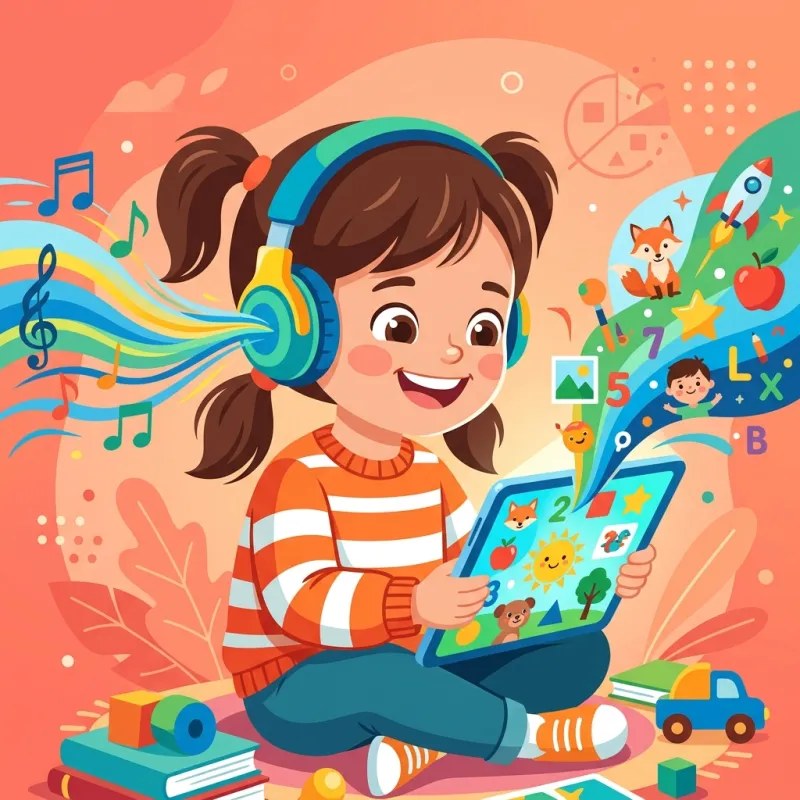
Well-designed educational apps can implement optimal repetition patterns automatically. Sikho Kids' Repeat Mode, for instance, allows children to loop through content as many times as needed, enabling the spaced repetition that memory research recommends. The Auto Swipe feature creates a natural rhythm of exposure that mirrors the pacing of effective classroom instruction — each item is presented long enough for processing but not so long that attention wanders.
The app's category-based organization also supports interleaved practice. A child might explore the alphabet category, then switch to numbers, then return to the alphabet. This natural variation prevents the monotony of single-focus drill while maintaining the repetitive exposure that learning requires.
Supporting Repetition at Home
Parents can support healthy repetition habits by embracing rather than fighting their child's desire to repeat activities. When your child asks to hear the same song again, to read the same book again, or to play with the same app module again, recognize that they are doing exactly what their brain needs to do. Each repetition is building stronger neural connections, even when it does not appear that anything new is being learned.
At the same time, parents can gently introduce variation within repetition. Read the same book but pause to ask different questions each time. Use the same app but draw attention to different aspects of the content. Sing the same alphabet song but change the tempo or volume. This approach respects the child's need for familiarity while adding the contextual variety that transforms rote repetition into rich, connected learning.
Repetition is not the enemy of creativity — it is the foundation upon which creativity is built. A child must first master the letters before they can write stories.
Understanding the essential role of repetition in early learning allows parents to be more patient, more intentional, and more effective in supporting their child's development. Rather than worrying about monotony, celebrate each repetition as another layer of myelin wrapped around a growing connection — another step toward mastery.