India is inherently multilingual. Most Indian children grow up hearing two, three, or even four languages in their daily lives — Hindi at home, English at school, a regional language with grandparents, and perhaps a neighborhood language with friends. Yet many parents worry that exposing young children to multiple languages will confuse them or delay their speech development. Modern research emphatically refutes these concerns. Bilingual exposure in early childhood is not a burden on the developing brain — it is a gift that confers cognitive, social, and cultural advantages lasting a lifetime.
The Bilingual Brain Advantage
Decades of neuroscience research have revealed that bilingualism fundamentally reshapes how the brain processes information, and almost always for the better. Bilingual children develop stronger executive function skills — the mental abilities that govern attention, working memory, and cognitive flexibility. These skills are the brain's command center, controlling everything from impulse regulation to problem-solving.
The reason is elegantly simple. A bilingual child's brain must constantly manage two language systems, activating the appropriate language for each context while suppressing the other. This continuous mental exercise strengthens the prefrontal cortex, the brain region responsible for executive function. It is as if bilingual children are doing cognitive push-ups every time they switch between languages, building mental muscle that benefits them across all areas of learning.
A landmark study by psychologist Ellen Bialystok at York University found that bilingual children outperformed monolingual peers on tasks requiring attention control, conflict resolution, and cognitive switching — even when the tasks had nothing to do with language. These advantages were measurable by age three and persisted into adulthood.
Debunking the Confusion Myth
One of the most persistent myths about bilingual education is that young children will become "confused" by exposure to multiple languages. Parents often cite code-switching — when a child mixes words from different languages in a single sentence — as evidence of confusion. But linguistic research tells a very different story.
Code-switching is not confusion; it is a sophisticated linguistic strategy. When a bilingual child says something like "Mujhe apple chahiye" (I want an apple), they are not confused about which language they are speaking. They are making a strategic choice to use the most readily available word for each concept, demonstrating flexible, creative language use rather than deficiency.
Research also shows that bilingual children reach language milestones — first words, two-word combinations, simple sentences — at the same age as monolingual children. While their vocabulary in each individual language may be slightly smaller than a monolingual child's single-language vocabulary, their total vocabulary across both languages is typically equal to or larger than their monolingual peers.
The Cultural Connection
In the Indian context, bilingualism is not just a cognitive exercise — it is a cultural lifeline. For families where Hindi, Tamil, Bengali, Gujarati, or other Indian languages are the mother tongue, maintaining the home language alongside English is essential for preserving cultural identity, family bonds, and a sense of belonging.
Children who lose their home language often lose the ability to communicate meaningfully with grandparents, extended family, and their broader cultural community. They may miss out on stories, songs, traditions, and cultural knowledge that are encoded in the home language. By contrast, children who maintain both their home language and the language of schooling grow up as cultural bridges, comfortable in multiple worlds.
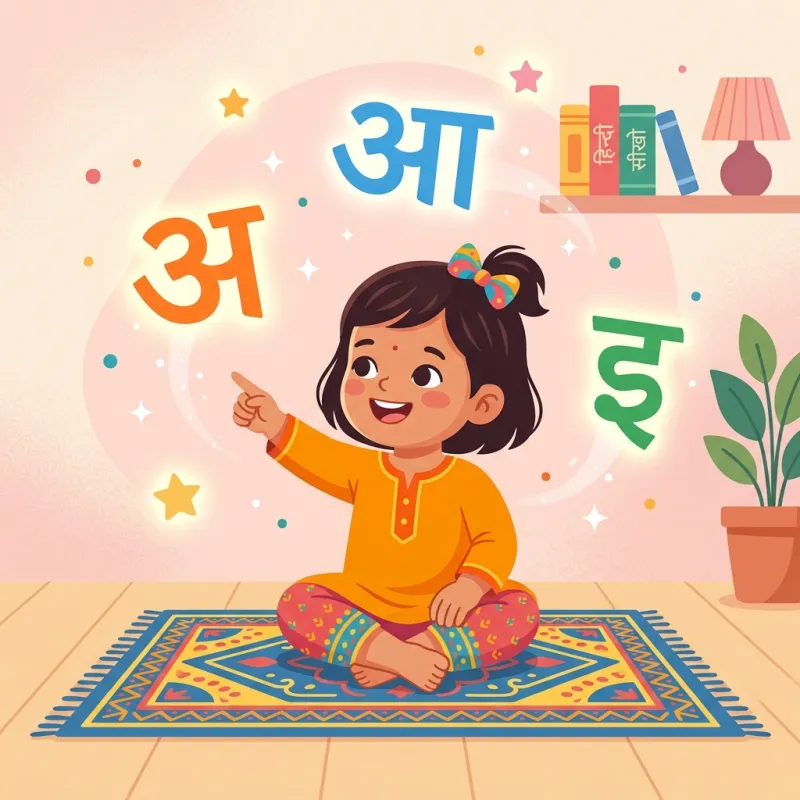
This is precisely why Sikho Kids includes the Hindi Varnmala module alongside English content. By providing beautifully designed flashcards with accurate Hindi pronunciation, the app supports families who want their children to develop foundational Hindi literacy alongside English. The bilingual capability means children can learn the same concepts — animals, fruits, colors, numbers — in both languages, building parallel vocabulary sets that reinforce each other.
Strategies for Raising Bilingual Children
Research has identified several effective strategies for supporting bilingual development in young children.
- One Parent, One Language (OPOL): Each parent consistently speaks one language with the child. This creates clear, predictable language contexts that help children distinguish between their two languages.
- Home Language/School Language: The family speaks the home language at home, and English is learned primarily through school and media. This ensures robust home language development while providing structured English exposure.
- Rich input in both languages: The quality and quantity of language input matters more than the specific strategy used. Children need to hear both languages used frequently, in varied contexts, by engaged speakers. Educational apps can supplement human input by providing consistent, accurate pronunciation models in both languages.
- Reading in both languages: Read books to your child in both languages regularly. If you are not comfortable reading in English, use apps and audiobooks to supplement. If extended family speaks the home language, enlist their help in reading and storytelling.
Digital Tools for Bilingual Learning
Technology can play a valuable role in supporting bilingual development, especially for families where one language has limited representation in the immediate environment. A family living in an English-dominant area can use Hindi-language apps, videos, and music to provide the Hindi input their child needs. Conversely, a family in a Hindi-dominant area can use English-language educational apps to supplement limited English exposure.
Sikho Kids is particularly well-suited for bilingual families because it offers the same educational content accessible in both English and Hindi. The language toggle feature allows seamless switching between languages, enabling children to learn the same concept in both languages during a single session. This direct comparison strengthens cross-linguistic connections and deepens understanding of both languages.
When to Start
The answer to "When should I start bilingual education?" is simple: as early as possible. The critical period for language acquisition extends from birth to approximately age seven, with the earliest years being the most fertile for phonological development. Children exposed to two languages from birth develop native-like pronunciation in both, while those who begin bilingual exposure after age six may retain a perceptible accent in the second language.
However, it is never truly too late. Even children who begin learning a second language after the optimal window can achieve high levels of proficiency, especially with consistent exposure and support. The key is regular, meaningful engagement with both languages — not perfection, but persistent, joyful practice.
Every language a child learns is a window to a new world. The more windows we open for them, the richer their view of the world becomes.
Raising bilingual children in India is not just possible — it is natural, beneficial, and deeply rewarding. With the right strategies and tools, parents can give their children the gift of linguistic flexibility that will serve them academically, professionally, and personally for their entire lives.