Few topics generate as much anxiety among modern parents as screen time. How much is too much? Is educational screen time different from entertainment? Should toddlers use tablets at all? These are questions that every family with young children grapples with, and the answers are more nuanced than the alarming headlines suggest. Understanding the research and developing a thoughtful, personalized approach to screen time can help parents feel confident in their decisions.
What the Research Actually Says
The American Academy of Pediatrics (AAP) provides the most widely cited guidelines on children's screen time. Their current recommendations distinguish between passive and interactive screen use, and between different age groups. For children aged 18 to 24 months, the AAP suggests introducing high-quality digital media only with parental co-viewing. For children aged 2 to 5, the recommendation is to limit screen time to one hour per day of high-quality programming or interactive content.
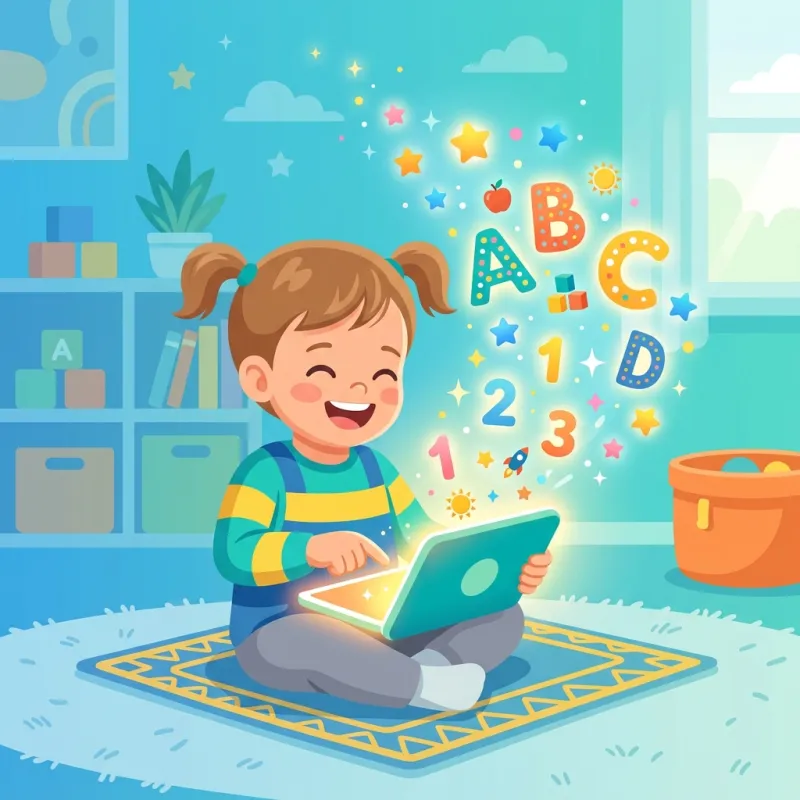
Critically, the AAP's guidelines acknowledge that not all screen time is equal. Interactive, educational content used in moderation — especially when accompanied by parental engagement — is viewed very differently from passive, extended consumption of entertainment media. An educational app that teaches Hindi Varnmala through interactive flashcards and audio reinforcement is a fundamentally different experience from a child mindlessly scrolling through videos.
Recent research from the University of Wisconsin-Madison found that children aged 2 to 3 who used interactive touchscreen apps showed significantly better word learning compared to those who watched the same content passively on a screen. The interactive element — the act of touching, choosing, and responding — appears to be the critical factor that transforms screen time from passive consumption into active learning.
Quality Over Quantity
Rather than fixating on exact minutes, parents are better served by focusing on the quality of screen content. High-quality educational apps share several characteristics that distinguish them from less effective alternatives.
- Clear educational objectives: Each interaction should teach something specific — a letter, a number, a word, a concept. Apps like Sikho Kids organize content into distinct categories (alphabets, numbers, animals, colors) so that learning goals are always clear.
- Age-appropriate design: Interfaces should be simple enough for toddlers to navigate independently, with large touch targets, intuitive gestures, and minimal text-based instructions.
- Minimal distractions: The best educational apps avoid pop-up ads, flashing banners, and unrelated mini-games that pull children away from the learning content.
- Audio reinforcement: Clear pronunciation of letters, words, and numbers helps children connect visual symbols with their spoken counterparts.
- Self-paced progression: Features like Auto Swipe and Repeat Mode allow children to control their learning pace, an important factor in maintaining engagement without causing frustration.
Building a Balanced Media Diet
The concept of a media diet is helpful for framing screen time decisions. Just as a healthy food diet includes a variety of nutritious foods in appropriate portions, a healthy media diet includes a variety of activities — both digital and analog — balanced throughout the day.
A typical day for a toddler might include fifteen minutes of educational app time in the morning, followed by outdoor play, then a short session of interactive reading on a tablet before lunch, followed by naptime, creative play with physical toys in the afternoon, and perhaps a brief app session before dinner. In this context, screen time is one ingredient in a rich, varied day — not the dominant activity.
The key is to ensure that screen time never displaces critical developmental activities: physical play, face-to-face social interaction, hands-on creative exploration, and adequate sleep. When parents view screen time as a complement to these activities rather than a competitor, the anxiety surrounding it tends to diminish considerably.
Co-Viewing and Co-Playing
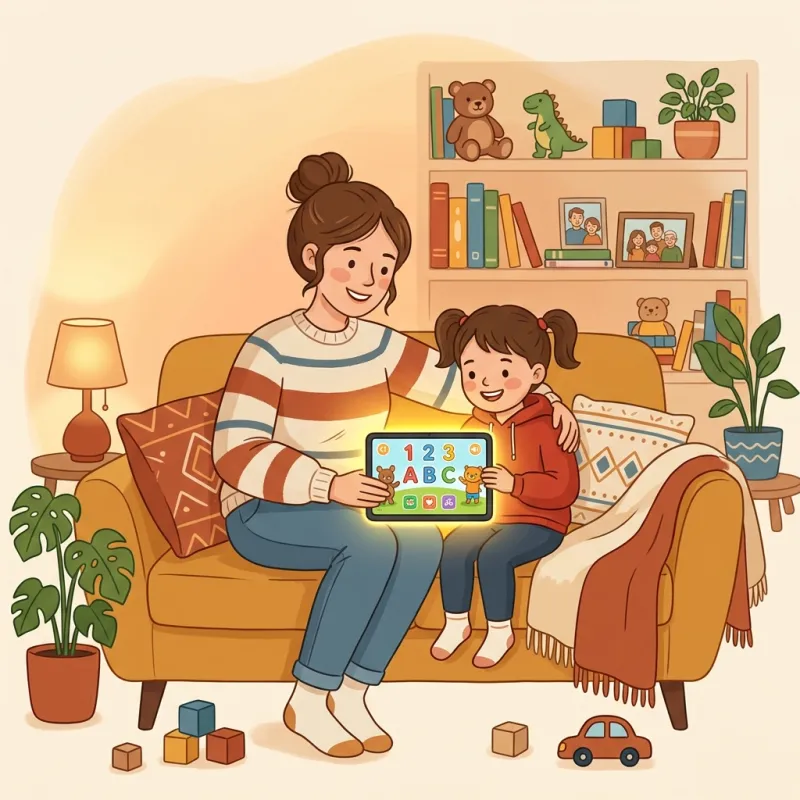
One of the most powerful strategies parents can employ is co-viewing or co-playing — sitting with their child during screen time and actively engaging with the content. When a parent points at a letter on the screen and says, "Look, that is the letter A! Can you say A?" they are transforming a solo digital experience into a shared learning moment.
Co-viewing serves multiple purposes. It helps parents monitor content quality in real time. It provides opportunities for extending learning through conversation and connection to real-world experiences. It models healthy technology use. And it strengthens the parent-child bond by creating shared experiences around learning.
Setting Boundaries with Compassion
Transitions away from screen time can be challenging for young children. Rather than abruptly taking the device away — which often triggers meltdowns — consider these strategies for smoother transitions. Give advance warnings by telling your child they have two more minutes before the app closes. Use natural stopping points by letting them finish the current letter or category before transitioning. Create consistent routines so that screen time happens at predictable times and is followed by enjoyable offline activities. Frame transitions positively by saying "Now we get to go play outside!" rather than "Screen time is over."
Signs That Screen Time Needs Adjustment
While moderate, supervised use of educational apps is generally beneficial, parents should watch for signs that screen time may need to be reduced or restructured. If a child becomes distressed when the device is taken away, if screen time is displacing physical activity or social interaction, if sleep patterns are disrupted, or if the child shows diminished interest in non-digital activities, these are signals to reassess the family's media habits.
The goal is not to eliminate screens from children's lives — that is neither realistic nor necessarily beneficial in our digital age. Rather, the goal is to integrate digital learning tools thoughtfully and intentionally, ensuring that technology serves the child's development rather than hindering it. With the right approach, educational screen time can be a valuable part of a child's learning journey.